
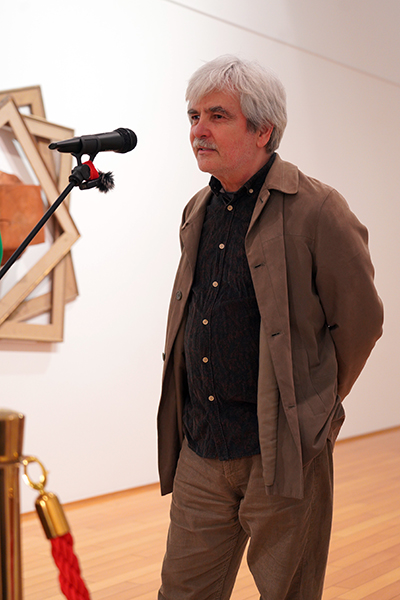
Born in 1962 in Belgrade. He graduated in 1987 from the Department of Sculpture at the Faculty of Fine Arts in Belgrade, in the class of Professor Miodrag Miša Popović, where he has been teaching since 1989. He completed his M.A. in 1992, and since 2011 he has held the title of Full Professor. A member of ULUS (Association of Fine Artists of Serbia) since 1988.
He has held 13 solo exhibitions and participated in numerous group exhibitions at home and abroad.
His works are included in many public and private collections.
He has received several awards:
University of Arts in Belgrade Award, 1984 and 1997.
October Prize of the City of Belgrade for the best professional and scholarly works by students, 1987.
City Self-Governing Community of Culture Award for best achievement, 1989, for the sculpture exhibition at the Kolarac Gallery.
“From April to April” Award, Studio B, 1996, for the best exhibition in the 1995–1996 season.
Annual Award for Best Solo Exhibition, Ilija M. Kolarac Endowment, 2010.
The Ivan Tabaković Fund Award, Serbian Academy of Sciences and Arts, 2010.
Grand Plaque of the University of Arts for the 2018/2019 academic year, for exceptional merit and contribution to the University of Arts in Belgrade, 2019.
INTERGROWTH
“Into wind, water, sunlight, starlight, there always entered
leaf and branch, bole and root, the shadowy, the complex.“
Ursula Le Guin, The Word for World Is Forest
Unlike most artists who work in a particular material (stone, wood, clay, metal, polyester, etc.), Dušan Petrović works in conjunction with the material itself, i.e. in a partnership, an equal, dialogical relationship. Although throughout his creative and exhibition career, spanning nearly four decades, he has produced sculptures in collaboration with stone, glass, and metal, he has achieved his most intense and enduring affinity with wood—it has been a constant in his work since his first solo exhibition, held in 1988 at the gallery of the Belgrade Student Cultural Center.
Very early on, Petrović established himself as an authentic and prominent figure on the local art scene. He is one of four artists (Joksimović, Krgović, Apostolović) who, in the late 1980s and early 1990s, through their innovative approaches and procedures, opened up a new creative field within Serbian/Yugoslav sculpture, designated as the “New Belgrade Sculpture.” At that time, Professor Ješa Denegri interpreted Petrović’s sculpture as being grounded in “the modernist ideal of a thoroughly realized form,” recognizing in it an affinity with the tendency of “modernism after postmodernism.”[1] Throughout all these decades, Petrović has consistently, without unnecessary detours or digressions, followed the creative premises he established at the very beginning of his artistic path.
His spatial works, ranging from associative, abstract, and engaged to social sculpture, constitute a complex and refined body of thought that reaches into diverse spheres and fuses a variety of approaches and perspectives—both those that are exact and scientific, from biology, botany, mineralogy, petrology, ecology, and craft skills, as well as those belonging to the broad spectrum of the humanities. Guided by the conviction that the creative act is, first and foremost, an ethical act, opposed to an anthropocentric understanding of the world, he creates works that are deeply humane and noble, at once engaged and ecologically aware.
Key points of support in Petrović’s creative process are intuition, knowledge, and a finely honed sensitivity to the properties of materials. Not infrequently, the material itself (often found) stimulates the initial idea for a work. On the one hand, his works are characterized by craftsmanship, precision, perfectionism, and an uncompromising commitment to realizing an idea; on the other, by a striving for absolute creative freedom, that is, a refusal to submit to any formal imperatives or constraints.
[1] Ješa Denegri, text in the exhibition catalogue Dušan Petrović: Sculptures and Drawings, Gallery of the Belgrade Youth Center, 1993.
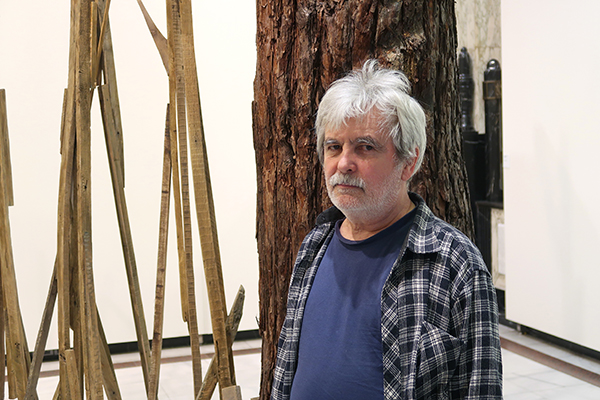
The forms of his sculptures, which always arise from a dialogue with the material, are unpredictable and invariably different. Each of his works is a precious and unrepeatable being, a sumptuous and unique identity. “His intention is for the idea to adapt to the material just as much as the material itself is an idea in its own right,” once observed Dušan’s colleague and friend, the sculptor Zdravko Joksimović. Moreover, since almost everything Petrović uses in his work consists of found, discarded materials, Joksimović describes him as a “master of the recycling and reanimation of materials.”[1]
In Petrović’s creative process, from discovering or recognizing the material to the final formulation of the form in the studio or gallery, a key role is given to chance, or rather, synchronicity—acausal “meaningful coincidences.” Often, material that seems entirely insignificant, worthless, or discarded leads him along a long, uncertain, and exciting creative path. His spatial creations combine elements of numerous attributes of contemporary artistic production: performativity, processuality, objet trouvé, ready-made, in situ, work in progress, and environment. Yet above all, they embody uniqueness and authenticity.
“The tree, a mediator between the earth and the sky, symbolizes both the chthonic and the uranic worlds. According to the general mythological schema of many peoples, the tree thus connects three levels of cosmic meaning: the underworld (the Hadic realm–roots), earthly signs of reality (the tree itself), and light–the sky (branches, canopy, crown).”
Kosta Bogdanović, Poetika bića drveta (The Poetics of the Being of the Tree)[2]
The principle and dramaturgical flow by which Petrović extends his works through the exhibition space of the Zepter Museum can be described as—intergrowth. He does not accept the limits of the so-called “white cube,” but rather occupies the space using the method by which vegetation does—spreading freely, in directions both with and against gravity, horizontally and vertically, visibly and hidden, rhizomatically. Observing the world and acting from a holistic perspective, with the conviction that humans and nature are (after all) one, he returns to the unnatural environment (both visually and semantically) nature’s refined artifacts.
[1] Zdravko Joksimović, “The Fantastic Reality of Matter,” text in the exhibition catalogue D. Petrović: The Great Cloak, Gallery 73, Belgrade, 2023.
[2] Kosta Bogdanović, Poetika bića drveta, Šumarski fakultet, Beograd, 2012.
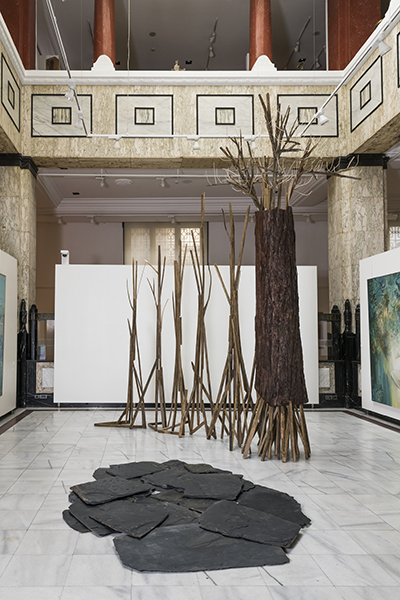
The dominant material of the From the Earth to the Sky installation is wood. The monumental work of the same name, which the visitor encounters first, signals Petrović’s fundamental belief that there is no distinction between life and non-life, organic and inorganic, the concrete, vegetative, and post-vegetative existence of a tree. Petrović recognizes all states and transformations of a tree as an active flow: growth, leafing, ring formation, transformation into functional objects—boards, beams, slats, sawdust—and then decay, burning, fossilization, conversion into oil, stone, ash, and various solid and gaseous products. Simply put, Petrović understands wood as a ubiquitous and all-pervading material, an alchemical materia prima.
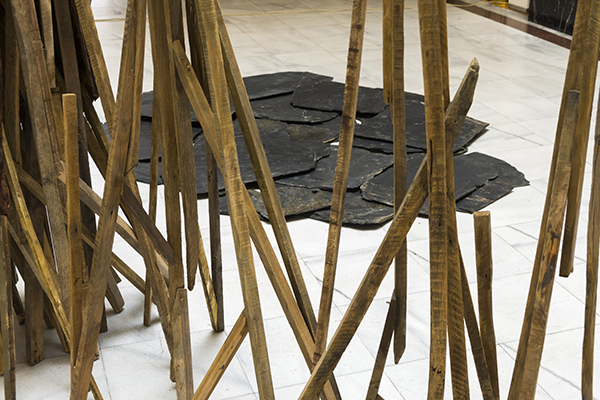
This work, which has fused with and grown into the museum environment—the building’s interior and the permanent museum display—is an exciting construction made from the noble, velvety bark of redwood and banal oak slats, joined in a life-giving rhythm of growth and continuous cyclical metamorphoses. As a shadow of this wooden construction, Petrović places stone slabs on the museum floor—layered metamorphic shale, once used as roofing tiles in the village of Maće on Golija.
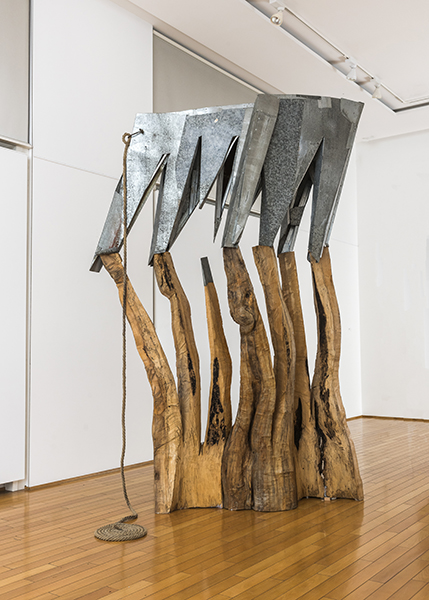
He continues this process of intergrowth with the striking sculpture Depths, which guides the viewer toward the monumental Parting, where two materials are confronted yet fused—hornbeam trees from Žagubica, on which the sculptor made entirely discreet interventions, and galvanized sheet metal, bearing visible, unaltered traces of duration and use in protecting houses from rainwater. Following the “wild” form of the trees, the sculptor shapes protective caps from metal, creating a kind of druidic temple or cathedral, where the points of contact, intersection, and fusion between wood and metal offer the viewer numerous exciting visual perspectives. Since this is Parting, he “anchors” the construction with a thick ship’s rope.
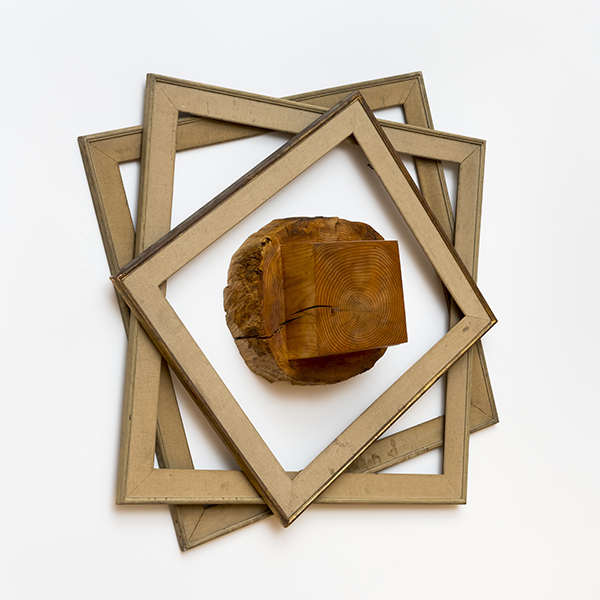
The prominent wall sculpture Memories, centered on a monolithic segment of cedar wood, unites two principles—natural and artificial. While the segment attached to the wall preserves the tree’s original state in full, its extension is worked into a rectangular profile, without compromising the compactness of the wood mass. A rock crystal discreetly growing between the rings—crossing the time of the tree’s growth with the time of the crystal’s formation and growth, as well as exact, calendrical time—introduces us to a new, barely comprehensible temporal dimension. Framed by old, discarded picture frames, which provide an artistic/museum context for the scene, the composition suggests the timelessness of both nature and art.
Finally, the starting section of the installation consists of the minimalist wall composition Untitled, made from parts of two former roof beams—beech and oak. By cutting the tops at an angle, Petrović reveals how, beneath the worn surface, a strong and healthy tree still persists. Through its form and color, vitality, and durability, this work visually grows into the gallery wall, opening a path toward timelessness and infinity.
Human beings have created a division between inanimate and living nature, thereby establishing a certain hierarchy of values. Petrović, with his entire being, opposes most anthropocentric assumptions; for him, the living and the non-living, the organic and the inorganic, exist on the same plane as precious substances which, in mutual harmony, constant exchange, and the flow of energies, build the planet’s ecosystem. Everything is in constant transformation, but the speeds of these changes differ. Crystals grow, trees communicate with one another, forests move, rocks disintegrate, prehistoric animals and trees emerge from the grip of millennial glaciers, nd fossils of various plants, insects, mollusks, and so on appear between the layers of mica. In other words, Petrović’s standpoint is that everything is alive, everything moves and transforms, though the speeds and temporal dimensions of that growth differ significantly.
Through his creative activity in such a world, Petrović undermines and renders meaningless the human demiurgic status as ruler of the world, placing humankind instead as a small, self-important particle within the vast system of nature.
Danijela Purešević